How I Taught 15 Future Founders to Build Their Digital Presence with AI Tools
The Full-Circle Moment
Some opportunities feel like full-circle moments. This was one of them.
In Fall 2023, I participated in the BREAK Fellowship. It was one of those rare programs that does not just give you information. It gives you perspective. It reminded me why early-stage community and peer learning matter more than most of us admit when we are deep in the building process.
So when the team reached out and asked if I would give back by running a workshop for the new cohort, saying yes was easy.
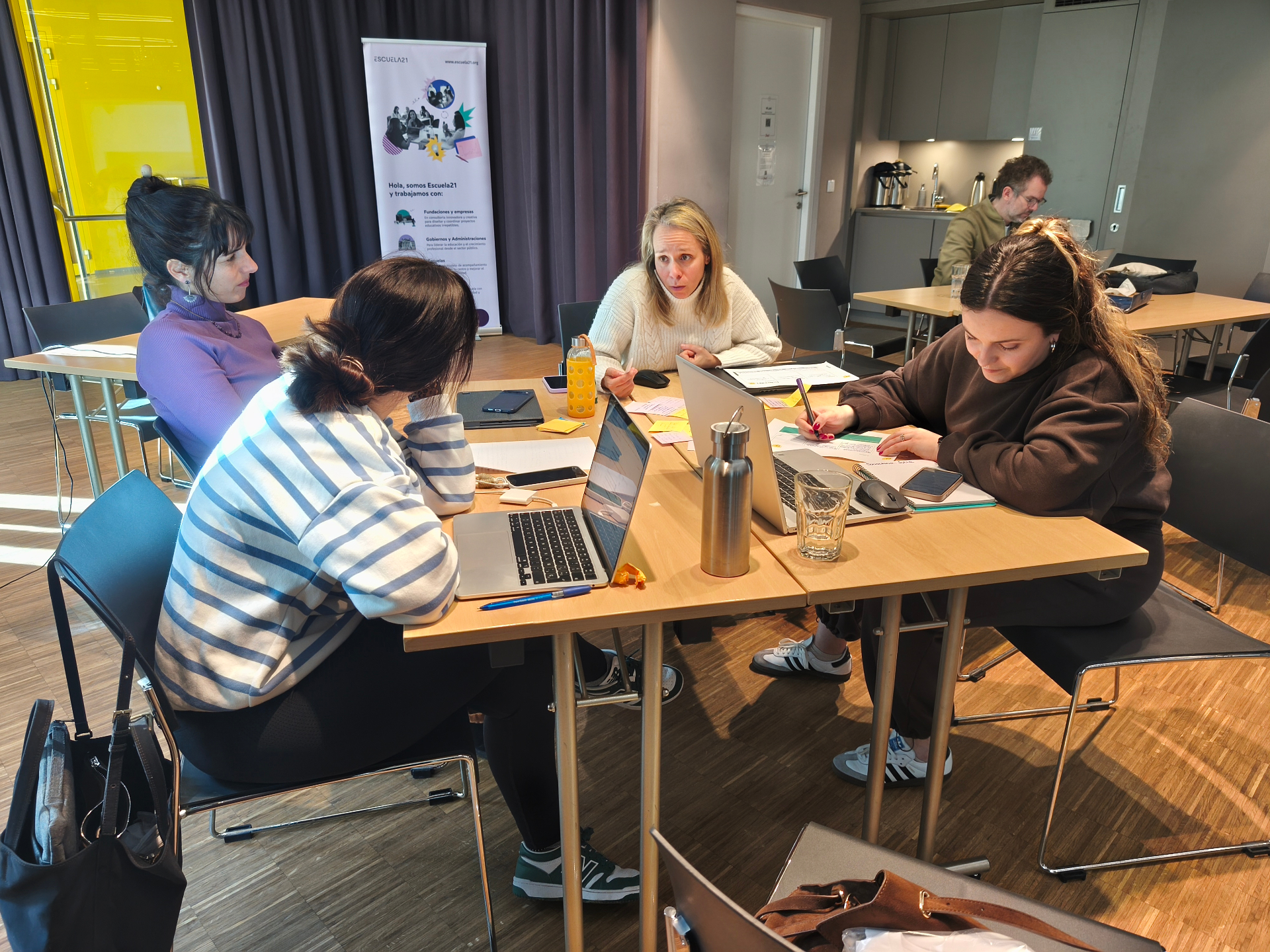
Fifteen soon-to-be founders made their way from Extraventura to Vienna. Not to pitch. Not to demo. To learn, to ask hard questions, and to leave with tools they could actually use the next day.
This post is a writeup of what we covered. If you were in the room, this is your reference. If you were not, this is what I would have told you.
The Problem No One Warns You About
Before we touched a single tool, we talked about the mistake almost every early-stage founder makes with their digital presence.
They build before they define.
They open a website builder, pick a template, start writing copy, and somewhere in the process realize they are not sure who they are writing for. The result is a website that looks polished but converts nothing, ranks nowhere, and reflects the founder's thinking rather than the customer's problem.
The fix is not a better template. It is a better brief.
Everything we covered in the workshop flowed from that one principle: your tools are only as good as the clarity you bring to them. AI amplifies direction. It does not replace it.
The Toolkit: Five Tools, One Workflow
We walked through five tools that, used together, take you from a raw idea to a live, optimized digital presence. Here is how they connect.
1. Perplexity: Research That Actually Respects Your Time
Most founders start their research on Google, jump between tabs, and end up with fifteen open windows and no clear answer. Perplexity changes that.
It is a conversational research tool powered by AI that synthesizes sources and gives you structured, cited answers. In the workshop, we used it to quickly map competitive landscapes, identify customer language, and pull together market context before writing a single word of copy.
The key is learning to ask it the right questions. Instead of "what is the market for sustainable packaging," you ask "what are the top three pain points expressed by small e-commerce brands when sourcing sustainable packaging, and what language do they use to describe them." The specificity of your question determines the usefulness of the answer.
We used Perplexity as the research layer. Everything it produced fed directly into the next step.
2. NotebookLM: Your Personal Briefing Document
Once you have research, you need a place to organize it. NotebookLM is a Google tool that lets you upload documents, reports, transcripts, and articles, and then have a conversation with that content.
In practice, this means you can upload your competitor analysis, your customer interviews, your own notes from a discovery call, and ask NotebookLM to synthesize them into a positioning brief. Or pull out the top recurring objections. Or identify the language gaps between how you describe your product and how your customers describe their problem.
We used NotebookLM to build what I call the briefing layer. Before any AI tool writes your website copy, it needs to understand your customer. NotebookLM helps you structure that understanding in a way you can then paste directly into a prompt.
3. Claude: Building a Master Prompt for Lovable
This is where things got practical fast.
Lovable is a vibecoding tool that lets you build functional websites and web applications through natural language prompts. You describe what you want, and it builds it. No code required.
But here is the thing most people miss: the quality of what Lovable builds is entirely determined by the quality of your prompt. A vague prompt produces a generic website. A precise, customer-defined prompt produces something that actually reflects your positioning, speaks to your specific audience, and has a shot at ranking.
We used Claude to build what I call a master prompt. This is a structured template that captures your customer profile, your core value proposition, your brand tone, your key pages, and your SEO intent, all in one reusable document.
The process works like this. You bring your Perplexity research and your NotebookLM brief into Claude. You ask Claude to help you structure a Lovable master prompt that incorporates your customer language, your positioning, and your technical requirements. Claude asks clarifying questions, pushes back on vague claims, and helps you sharpen the brief until it is ready to use.
The result is a prompt you can reuse across every Lovable session. Every new page, every update, every component, starts from the same customer-defined foundation. You stop drifting away from your positioning every time you sit down to build.
I have a set of prompt templates on the FutureHabits.Tech website designed specifically for Lovable. They give you a starting structure you can customize, which means you spend less time figuring out what to write and more time building. They also help you use your Lovable credits more efficiently, because fewer revision cycles means less usage burned on getting back to a baseline.
4. Lovable: Building the Website
With a master prompt in hand, we opened Lovable.
For anyone who has not used it: Lovable is extraordinary for founders who have a clear product vision but no development background. You can go from a blank screen to a live, deployable website in under two hours if you know what you are building and for whom.
The workshop walked through the core workflow. Starting with a homepage that leads with the customer problem, not the product feature. Structuring navigation around the buyer journey, not the founder's org chart. Adding clear calls to action that reflect where your customer is in their decision process.
We also covered one of the most important technical considerations for AI-built websites: client-side rendering and what it means for your visibility.
By default, Lovable builds sites that render content in the browser using JavaScript. This is fine for users. It is a problem for search engines and AI crawlers, which often cannot read JavaScript-rendered content. If your website is not prerendered, or if you have not addressed structured data and metadata, your site is effectively invisible to Google and to AI discovery tools.
This is not a Lovable-specific problem. It is a vibecoding problem that affects most no-code and AI-built websites. We covered the basics of how to address it, which brings us to SEO and GEO.
5. Gamma.app: Making Your Thinking Presentable
Not every founder needs a pitch deck in week one. But every founder eventually needs to communicate their thinking to someone who was not in the room when they figured it out. An investor, a partner, a potential hire, an accelerator application.
Gamma.app is an AI-powered presentation builder that produces clean, professional slides from a text prompt or structured outline. You paste in your positioning, your problem statement, your solution, and your early traction, and Gamma builds a deck that looks like it was designed by someone who knows what they are doing.
In the workshop, we used the master prompt structure we had already built for Lovable as the input for a Gamma presentation. This is the benefit of having a single, well-defined customer brief at the center of everything you build. Your website, your pitch deck, your one-pager, your social content, they all start from the same foundation. They sound like the same company, because they are briefed from the same document.
SEO and GEO: The Part Most Vibecoded Websites Get Wrong
We spent meaningful time on this because it is where I see the most preventable failures.
SEO, search engine optimization, is still the most reliable channel for organic discovery. But the rules have shifted. Google no longer just rewards keyword density. It rewards topical authority, page experience, structured data, and content that genuinely matches what users are searching for.
GEO, generative engine optimization, is newer and increasingly important. As more people use AI tools like ChatGPT, Perplexity, and Claude to find information and products, the question is no longer just "does Google rank my page" but "does an AI model reference my content when someone asks a relevant question."
The foundations are the same: clear structure, schema markup, accurate metadata, fast load times, and content that demonstrates expertise and specificity. But the strategic intent shifts slightly. For GEO, you want your content to be the definitive answer to a narrow, specific question. Not the best general overview. The clearest, most specific answer to something your customer is actively asking.
For vibecoded websites specifically, the most common issues we see are missing meta descriptions, no structured data markup, poor heading hierarchy, and content that is too generic to rank for anything useful. We covered how to audit for these issues and how to use Claude to help write the structured data markup and metadata once your Lovable site is live.
What I Told the Room at the End
The tools change. They will be different in six months. Something will replace or extend what Lovable and Perplexity do today, and founders who built their identity around a specific tool will have to start over.
But the underlying skill does not change. The ability to define your customer before you build. To brief an AI tool the way you would brief a talented contractor. To know the difference between a website that looks good and a website that works.
That is the skill worth developing. The tools are just the current best expression of it.
If you were in the room in Vienna, thank you for showing up with the energy you brought. The questions were sharp, the curiosity was real, and I left that session genuinely energized. I am rooting for every one of you.
Want to Apply This to Your Own Website?
If you have a Lovable site that is live but not performing, or if you are about to start building and want to do it right from the beginning, this is exactly what we work on in our workshops.
We cover the full workflow from brief to build to optimize, and you leave with a master prompt, a working website, and a clear plan for getting found.
Book a workshop here and let us build something that actually works.