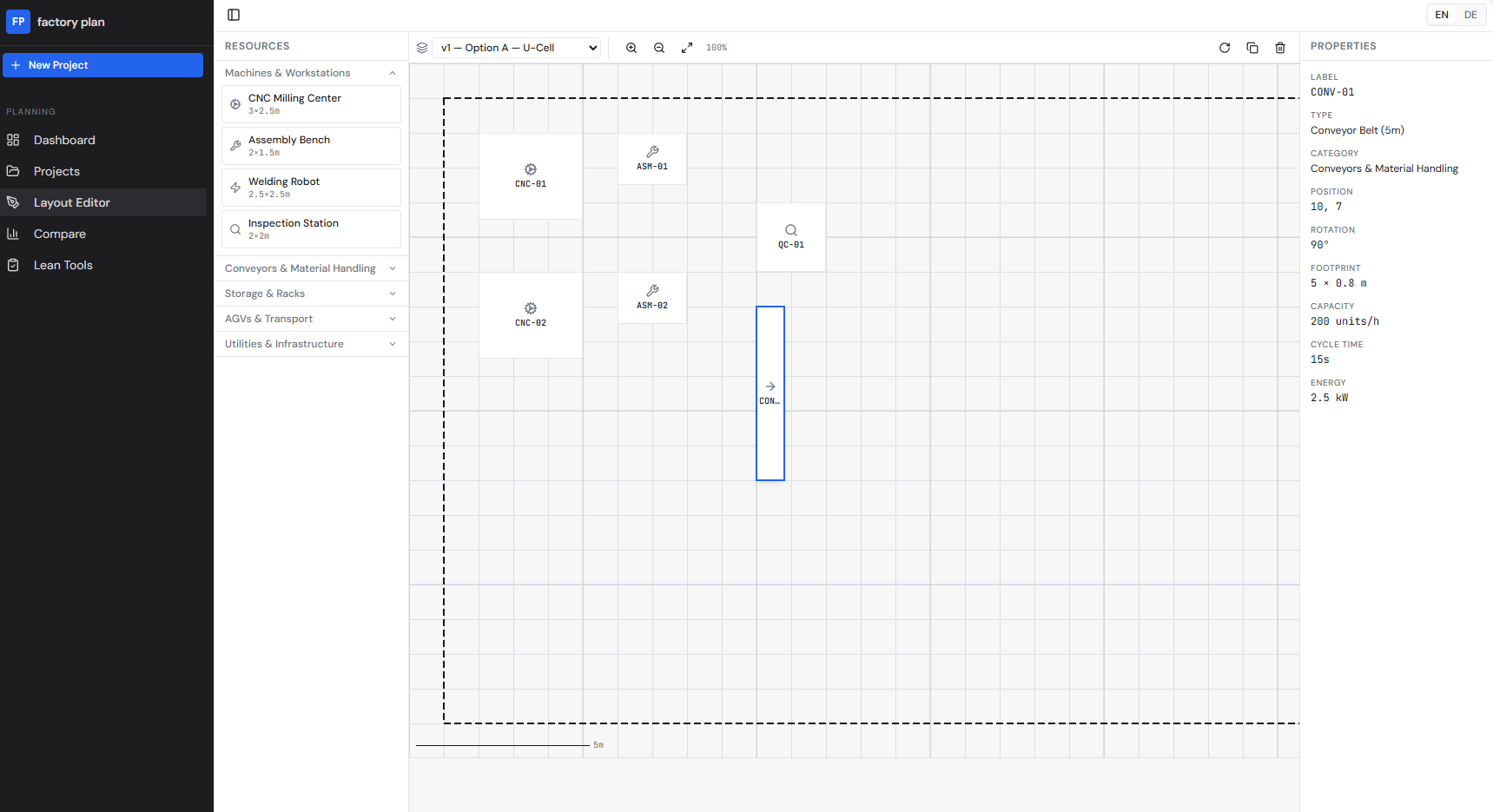
A Vienna-based B2B deep-tech startup working in industrial software engaged Kasia Sadowska to support the rapid development and validation of a separate simulation demonstrator. Through AI-assisted prototyping, structured user interviews, and iterative testing, a testable MVP was created within six weeks of focused part-time work inside a three-month calendar window. The demonstrator helped the team evaluate user needs and product assumptions before deciding how selected concepts could be incorporated into the long-term product roadmap.
This was a separate research and demonstration MVP, built to validate ideas and assumptions. It was not the company's core platform, production architecture, or enterprise software.
The engagement followed the FutureHabits approach: ship early, validate assumptions with structured interviews, and treat every iteration as a chance to refine both the product and the team's way of working with AI tools.
Interview, Build, Show, Repeat
There was no upfront discovery phase. The project ran on continuous discovery from week one, with discovery and delivery in parallel: interview, build, show, then interview again. Inside that loop, informal product "vibes" became precise prompts, constraints, and success criteria, and stakeholder goals like speed, cost reduction, and maintainability turned into structured prompts and technical acceptance criteria.
The tool stack was picked for outcomes, not novelty: AI-assisted research, AI-assisted prototyping and coding tools, a lightweight tool for work breakdown, and product analytics to observe real usage.
Prototype interviews anchored every cycle. Domain experts and stakeholders walked through early scenarios, challenged assumptions about speed, usability, and cost savings, and every session ended with concrete changes to prompts, demonstrator logic, or UI flow.
A Skeleton in Days, Depth in Weeks
AI-assisted prototyping tools assembled a working demonstrator UI in days: core inputs and outputs wired up, enough to run early scenarios and demos. AI-assisted coding and optimization tools then added depth, improving calculation accuracy, edge-case handling, and performance, and running mini security and optimization audits on critical functions.
Short optimization cycles fed test results, interview feedback, and analytics insights back into calculation logic and UI layout. That cadence is what compressed months of engineering into weeks.
Watching Users, Not Guessing
The work was broken into clear, trackable packages: demonstrator logic, data model alignment, security checks, and UX refinement.
Product analytics recorded how users actually moved through the demonstrator. The data exposed confusing flows and dead ends, showed which inputs and views users touched most, and guided simplification until the demonstrator felt intuitive rather than expert-only. Combined with the ongoing interviews, this created a tight loop between observed behavior and qualitative feedback.
Weeks, Not Quarters
The project did not end with a demo. It was handed over with easy-to-follow guidelines and a clear roadmap for how selected concepts could be incorporated into the long-term product roadmap, so the internal team can carry the work forward on its own.
Knowledge sharing with the team was just as important as the handover documents. The goal was not only a smooth transition, but giving the team the methodology and tools to keep improving the product and validating assumptions on their own long after the engagement ended.
"It was a pleasure working with Kasia. She was consistently reliable, thorough, proactive, and highly independent, while also thinking ahead, contributing valuable ideas, delivering a strong prototype, and communicating with customers in a professional and respectful manner. We would be very happy to work with Kasia again and can recommend her without hesitation."
AI is not just a set of tools. It is a way of working that has to become a habit. This project shipped in weeks instead of quarters, validated more assumptions with fewer meetings, and treated every deployment as another opportunity to refine prompts, models, and UX rather than a one-off milestone.
If you want to see what six focused weeks can do for your product, let's talk.
Useful UI is curated, not generated by default
For industrial simulation planning, speed only matters if the planner can understand the result. AI was an implementation partner, not the design authority. Each review asked whether the interface helped a domain expert make a decision or merely looked like a polished dashboard.
- One primary task per view: the next planning action stays obvious instead of competing with generated widgets.
- Domain language before generic copy: labels describe the planner's inputs, scenarios and outputs in the words experts actually use.
- Visible system state: users can tell which scenario they are viewing, what changed and whether a result is ready.
- Deliberate hierarchy: typography, spacing and colour highlight the decision, not every element at once.
The same review method is documented in the guide to avoiding AI-slop UI in Lovable. It is a repeatable step between the first generated version and a product worth showing to users.
Security belongs in the MVP conversation
This demonstrator was separate from the company's production platform. Even so, the handover made the data boundaries for any future production use explicit. Before connecting real customer data or opening access beyond the test group, a similar MVP should pass these checks:
- Keep private API keys in server-side functions; never place them in browser code or prompts.
- Define who may read and change each organisation's rows, then test those rules with an unauthorised account.
- Validate inputs and treat AI output as untrusted content rather than executable instructions.
- Use synthetic or approved test data until the data owner has approved the production setup.
- Check exports and logs for sensitive values, not only the main application screens.
The Protect your data guide walks through these boundaries in more detail. A fast prototype is useful when it makes assumptions testable. It should not make data ownership ambiguous.
Build the learning loop, then build the product
The same method works as a hands-on MVP workshop or as end-to-end product support: structure the assumptions, build the smallest useful flow, review the UI with domain experts and check the data rules before production. FutureHabits.Tech can facilitate that process with your team or lead it with you. Explore MVP development or book a call.